
Key facts at a glance
This page is one chapter of our guide on how to sell a house in Connecticut. It answers one question for one town: how to sell a house in an Old Saybrook flood zone. Every number below is sourced.
| Fact | Number | Source |
|---|---|---|
| Old Saybrook’s current effective flood map (FIRM) | February 6, 2013 | FEMA NFIP Community Status Book (community 090069) |
| Flood questions on the seller’s disclosure report | 6, in a “Flood Risk Awareness” section, since July 1, 2025 | Public Act 25-33, sec. 3 (CGS 20-327b) |
| Credit if the seller gives no disclosure report | $500 to the buyer at closing | CGS 20-327c |
| Substantial improvement threshold in a flood zone | 50% of the building’s market value | 44 CFR 59.1 |
| Old Saybrook single-family sales, Oct 2024 to Sep 2025 | 142, median $698,000 | data.ct.gov sales file |
| Of those, sold for $800,000 or more | 52 (37%) | data.ct.gov sales file |
| Mill rate, fiscal 2027 | 15.77 | OPM via data.ct.gov |
| Conveyance tax an Old Saybrook seller pays (up to $800,000) | 1% (0.75% state + 0.25% town) | CGS 12-494 |
Why does selling a flood-zone house in Old Saybrook feel so uncertain?
Selling a flood-zone house in Old Saybrook feels uncertain because the questions are technical, the stakes are high and the answers seem to depend on maps, insurers and lenders you do not control. Owners in this spot often feel anxious about the new flood questions, defensive about the house, worried the buyer’s insurance quote will kill the deal and unsure what they are allowed to fix. This page is for you.
Maybe the water came up your street in a nor’easter, or you filed a flood claim years ago and wonder if it follows the house. Or your parents owned a cottage near the Sound, and you now hold the insurance bill, the tax bill and a house that needs work before winter.
A flood zone does not make a house unsellable. Old Saybrook recorded 142 single-family market sales in the year to September 2025. What a flood zone changes is who can buy, how they pay, and what they need from you.
I am Jerryll Noorden. I have bought houses in Connecticut since 2016, about ten a year. I am not your agent or your attorney; every rule below links to its official source.
Can you sell a house in a flood zone in Old Saybrook, CT?
Yes, you can sell a house in a flood zone in Old Saybrook, CT, on the open market or to a cash buyer. You must answer the six flood questions on Connecticut’s disclosure report, your buyer’s lender will require flood insurance if the house is in a high-risk zone, and any major repair or renovation is limited by the 50% substantial-improvement rule. Prepared sellers close these sales every year.
Three things decide how smooth the sale is: the zone (X sells like any house; AE and VE need flood insurance for a mortgage), the paper (an assignable policy, an elevation certificate, an honest claim history) and the condition (unrepaired flood damage narrows the buyers to cash and builder buyers). For how cash buyers work statewide, see cash home buyers in Connecticut.
What flood zone is my Old Saybrook house in?
Your Old Saybrook house’s flood zone is shown on FEMA’s Flood Insurance Rate Map, which for Old Saybrook has been effective since February 6, 2013. Look up your address on FEMA’s Flood Map Service Center. VE zones face wave action, AE zones face still-water flooding up to a base flood elevation, AO zones face shallow flooding, and X zones are moderate or lower risk.
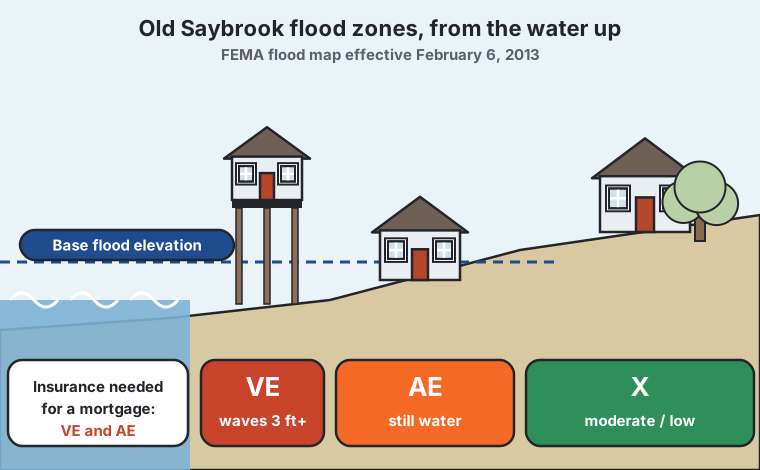
The zones you will see in Old Saybrook:
| Zone | What it means | What it means for your sale |
|---|---|---|
| VE | Coastal high hazard area: 1% annual flood chance plus waves of 3 feet or more | Strictest building rules, highest premiums, fewest financed buyers |
| AE | 1% annual flood chance, with a base flood elevation (BFE) set | Lender requires flood insurance; elevation decides the premium |
| AO / AH | Shallow flooding, 1 to 3 feet | Same insurance requirement as AE |
| X (shaded) | 0.2% annual flood chance, or protected areas | Insurance not required by lenders, but often wise |
| X (unshaded) | Minimal mapped flood hazard | Sells like any inland house |
The map line runs through lots: a house can sit in the X zone while the back yard is AE, and insurance looks at the building. If a surveyor shows the house is above the base flood elevation, you can ask FEMA for a Letter of Map Amendment (LOMA) to remove the building from the high-risk zone, which can widen your buyer pool more than any repair.
What do I have to disclose about flooding when I sell in Old Saybrook?
When you sell in Old Saybrook you have to answer six flood questions on Connecticut’s Residential Property Condition Disclosure Report: your FEMA zone, any federal or state disaster aid for flood damage, whether a flood policy is in force, whether an elevation certificate exists, any flood claims you filed, and any water penetration from seepage or a natural flood. Public Act 25-33 added these questions from July 1, 2025.
The same act added a printed notice to the form: lenders require flood insurance in a Special Flood Hazard Area, a requirement tied to past federal disaster aid “affixes to the property and applies to all future owners,” and FEMA maps are not a reliable tool for judging a property’s real flood risk (Public Act 25-33, sec. 4).
If you do not deliver the report, Connecticut law requires a $500 credit to the buyer at closing (CGS 20-327b and 20-327c). The credit does not cancel the duty not to hide a known defect. Our full guide to the Connecticut property condition disclosure walks through every question, including the flood section.
You also sign the smoke and carbon monoxide detector affidavit at closing (CGS 29-453). Since Public Act 23-164 there is no longer a cash credit option in place of the affidavit, so check the detectors before you sell, even in a cottage you plan to sell as-is.
The disaster-aid question matters most: if FEMA or SBA aid was paid for flood damage, the duty to keep flood insurance passes to the next owner, so say so up front.
How does flood insurance affect selling a flood-zone house in Old Saybrook?
Flood insurance affects selling a flood-zone house in Old Saybrook because any buyer with a federally backed or regulated mortgage must carry it if the house is in a high-risk zone, so the premium becomes part of what the buyer can afford. You can usually assign your National Flood Insurance Program policy to the buyer at closing, which passes along its rate and discounts.
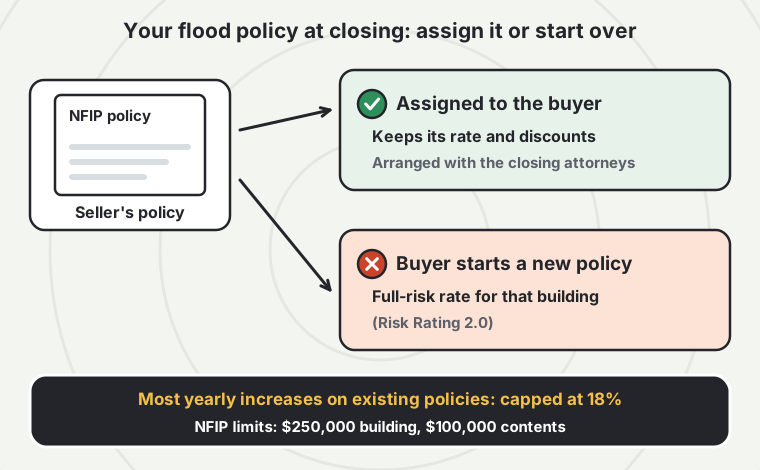
What a seller should know:
- The mandatory purchase rule. Federal law requires flood insurance on a building in a Special Flood Hazard Area when it secures a loan from a federally regulated or insured lender (42 U.S.C. 4012a). A cash buyer is not bound by this rule.
- Risk Rating 2.0. Since FEMA’s current rating method took effect for new policies in October 2021, premiums reflect each building’s own risk (distance to water, elevation, rebuilding cost) rather than only its map zone. Most annual increases on existing policies are capped at 18% by law.
- Assignment. FEMA lets a policyholder assign the policy to the new owner when the property sells, carrying over its discounts. A buyer who starts a new policy pays the full-risk rate for that building.
- Coverage limits. NFIP covers up to $250,000 on the building and $100,000 on contents; some buyers add private coverage.
Premiums vary house by house, and we found no public Old Saybrook average. Give serious buyers your current declarations page: a known premium is a cost; an unknown one is a fear. FEMA’s Community Status Book listed no Community Rating System class for Old Saybrook when checked, so the town-wide CRS discount some shoreline towns earn does not appear to apply; confirm with your agent.
Do I need an elevation certificate to sell my Old Saybrook house?
You do not need an elevation certificate to sell your Old Saybrook house, and since Risk Rating 2.0 one is no longer required to buy an NFIP policy. But Connecticut’s disclosure form now asks whether one is available, and an elevation certificate showing the lowest floor above the base flood elevation can lower the buyer’s premium or support a Letter of Map Amendment.
An elevation certificate is FEMA’s form, completed by a licensed surveyor or engineer, recording the zone, the base flood elevation and the elevation of the lowest floor. Before paying for a new one, check your own closing file, your insurance agent and the Old Saybrook Building Department, which may hold one from a permit. A new one is worth it when the house was elevated, was built to the 2013 map, or sits near a zone edge; it is rarely worth it on a low cottage you are selling as-is, because a cash buyer prices the risk anyway.
What is the 50% rule, and how does it affect a flood-zone sale in Old Saybrook?
The 50% rule says that if the cost of improving or repairing a building in a high-risk flood zone equals or exceeds 50% of the building’s market value, the whole building must be brought up to current flood standards, which usually means elevating it above the base flood elevation (44 CFR 59.1 and 60.3). In Old Saybrook, the town’s floodplain management ordinance (Town Code chapter 128) applies the rule through its flood review permit.
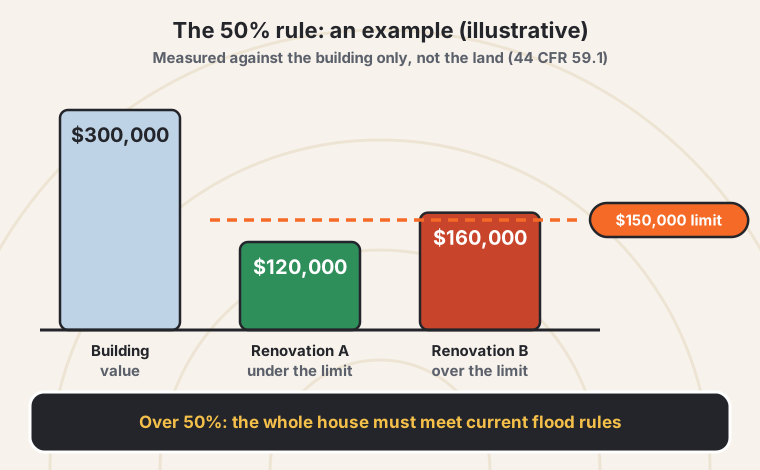
Why a seller should care: buyers do this math before they offer.
| Example (illustrative) | Amount | How it is figured |
|---|---|---|
| Market value of the building (not the land) | $300,000 | Appraiser or assessor’s building value |
| Substantial improvement limit | $150,000 | 50% of $300,000 |
| Kitchen, baths, roof and systems | $120,000 | Under the limit: repair without elevating |
| Full gut and addition | $160,000 | Over the limit: bring the whole house into compliance |
For a seller this means a big pre-sale remodel can cross the line and force an elevation project you never planned, and buyers price that ceiling into their offers. Storm damage of 50% or more is “substantial damage” under the same rule; NFIP’s Increased Cost of Compliance coverage can pay up to $30,000 toward elevating after such a determination, so ask your insurer.
Our guide to selling a house that needs repairs in Connecticut covers the repair-or-sell decision more broadly.
What does an Old Saybrook flood-zone seller net?
What an Old Saybrook flood-zone seller nets is the sale price minus the mortgage payoff, 1% conveyance tax up to $800,000 (more above it), attorney fees and any commission, minus the property tax and insurance credits settled at closing. On a $698,000 sale, conveyance tax alone is $6,980, and the house costs about $642 a month in property tax while it waits.
| Item | Old Saybrook example | How it is figured |
|---|---|---|
| Sale price | $698,000 | Single-family median, Oct 2024 to Sep 2025 |
| State conveyance tax | $5,235 | 0.75% of $698,000 (CGS 12-494) |
| Town conveyance tax | $1,745 | 0.25% of $698,000 |
| Assessment | $488,600 | 70% of value (CGS 12-62a) |
| Property tax per year | $7,705 | $488,600 x 15.77 / 1,000 |
| Property tax per month while it sits | $642 | Year / 12 |
| Conveyance tax on a $900,000 sale | $9,500 | 0.75% on $800,000 + 1.25% on $100,000 + 0.25% town |
With 52 of 142 single-family sales at $800,000 or more, many Old Saybrook sellers cross into Connecticut’s higher state conveyance rate. Our conveyance tax guide has the full table. To test your own net:
How much would you walk away with?
Slide the numbers to match your house. It works in your browser; nothing is saved or sent.
Estimates for planning. Conveyance tax per CGS 12-494 (state 0.75% up to $800,000, 1.25% to $2.5M, 2.25% above, plus the town rate). Seller attorney about $1,200 to $1,500; flat-fee MLS about $400; listings include three months of taxes, insurance and utilities, a cash sale about two weeks. Your attorney gives you the final numbers.
Who buys flood-zone houses in Old Saybrook?
Flood-zone houses in Old Saybrook are bought by financed buyers who accept the flood insurance cost, cash buyers and second-home buyers who do not need a mortgage, builders who plan to elevate or rebuild to current standards, and investors who buy houses as-is. Which buyer pays most depends on the zone, the elevation and the condition of the house.
Financed retail buyer
Highest price, if insurableBest for a sound house in an X or AE zone with a known premium.
- Needs a flood policy for the loan
- Inspection and appraisal contingencies
- 30 to 60 days to close after an offer (est.)
Builder or second-home cash buyer
Buys the locationBest for a low cottage on a good lot, especially in VE or AE.
- Prices the land and the rebuild
- No lender flood requirement
- Often needs zoning and coastal approvals
As-is cash buyer
About 2 weeksBest for flood damage, an estate or a deadline.
- No repairs, no showings, no commission
- No lender, no flood-insurance condition
- Price below a fixed-up retail sale
We compare the routes on cash buyer vs. realtor in Connecticut and explain offer math in why cash offers are so low. An as-is buyer prices in the 50% rule, the insurance and the repairs; selling a house as-is in Connecticut explains why you still answer the disclosure questions.
Is a cash sale right for you, or should you list?
Seven quick questions. There is no wrong answer, and we will tell you honestly if listing would leave you more.
- Does the house need repairs you would rather not pay for or manage?
- Do you need to close by a certain date, or within the next month or two?
- Would showings be hard: tenants, belongings, privacy, or you live out of state?
- Is there a complication: an estate or probate, a divorce, foreclosure, liens or back taxes?
- Could you comfortably cover the mortgage, taxes and utilities for three or more months?
- Is getting the highest possible price more important to you than speed and certainty?
- Would a buyer's bank lend on the house as it is (no major roof, foundation, oil tank or code issues)?
When should you NOT sell your Old Saybrook flood-zone house to a cash buyer?
You should not sell your Old Saybrook flood-zone house to a cash buyer when it is in good condition, insurable at a premium buyers can live with, and you have time to list it. A sound house in an X or AE zone with an elevation certificate and an assignable policy will usually net more on the open market, because a cash buyer has to price in risk and resale.
I buy houses for cash, and a dry, well-kept colonial behind the shaded X line does not need me. It needs a good listing photo and a copy of the flood declarations page.
A cash sale fits better when flood damage was never fully repaired, repairs would cross the 50% line, the premium scares off financed buyers, or heirs who live away face a winter with a vacant shoreline house. Before you sign with any buyer, read we buy houses scams and red flags.
What steps should I take to sell my Old Saybrook house in a flood zone?
The steps to sell your Old Saybrook house in a flood zone are to confirm your FEMA zone, gather your flood paperwork, answer the disclosure report’s six flood questions, decide whether to repair or sell as-is with the 50% rule in mind, and compare a listing net with a written as-is offer.
Confirm the zone
Look up your address on FEMA’s Flood Map Service Center and note the zone and base flood elevation for the building, not just the lot.
Gather the paper
Flood policy declarations page, any elevation certificate or LOMA, claim history, and records of repairs and permits after any storm.
Answer the flood questions
Complete the six “Flood Risk Awareness” questions honestly. Unknown is an allowed answer; a guess is not.
Decide repair or as-is
Price any work against the 50% rule before you start. Ask the building department if a project would be a substantial improvement.
Compare two numbers
Get a listing estimate and a written as-is offer, then compare the nets. Our Old Saybrook page explains how we make an offer; there is no deadline on it.
See the house together.
Pick a time that works.
Choose a time for us to walk through the property with you, or ask for a quick call first. We confirm every request personally.
Tuesday, January 13
No open times in the next few weeks. Please call us.
We will confirm by email. Nothing is booked until we do.
View my requestQuestions Old Saybrook owners ask about selling in a flood zone
Is it harder to sell a house in a flood zone in Old Saybrook?
It is harder to sell a house in a flood zone in Old Saybrook only when the house is in a high-risk AE or VE zone with a high premium, flood damage or no paperwork. Financed buyers need flood insurance there, so a known premium and an elevation certificate make the sale much easier.
Do I have to tell a buyer my Old Saybrook house is in a flood zone?
Yes, you have to tell a buyer your Old Saybrook house is in a flood zone. Since July 1, 2025, Connecticut’s disclosure report asks for the FEMA zone, disaster aid, flood insurance, elevation certificate, claims and water penetration (Public Act 25-33).
Can I transfer my flood insurance to the buyer?
You can usually transfer your flood insurance to the buyer by assigning your NFIP policy at closing. FEMA says the policy’s discounts carry over to the new owner when it is assigned. Ask your insurance agent to arrange it with the closing attorneys.
When did Old Saybrook’s flood maps last change?
Old Saybrook’s flood maps last took effect on February 6, 2013, according to FEMA’s Community Status Book. Check FEMA’s Flood Map Service Center for any newer revision or letter of map change for your address.
Will a cash buyer require flood insurance?
A cash buyer will not be required by federal law to carry flood insurance, because the mandatory purchase rule applies to loans from federally regulated or insured lenders. A prudent cash buyer still prices the flood risk into the offer.
What happens if my Old Saybrook house had flood damage?
If your Old Saybrook house had flood damage, you disclose it and any claims or disaster aid on the report. If the damage was 50% or more of the building’s value, the town may treat it as substantial damage, which requires bringing the building up to flood standards before it is rebuilt.
Should I elevate my house before selling it?
You should rarely elevate your house just to sell it: it is a months-long permitted project, and buyers who want an elevated house often prefer to choose the design.
How much is the conveyance tax on an Old Saybrook sale?
The conveyance tax on an Old Saybrook sale is 1% up to $800,000: 0.75% to the state and 0.25% to the town, so $6,980 on a $698,000 house. The state rate rises to 1.25% on the part of a residential price above $800,000 (CGS 12-494).
Related guides
- Cash home buyers in Connecticut: what they pay
- Cash buyer vs. realtor in Connecticut
- Connecticut property condition disclosure
- Sell a house as-is in Connecticut
- How a cash offer is built for a New Haven multi-family
- Property taxes when selling a house in Hamden
- How long it takes to sell a house in Wallingford
- We buy houses in Old Saybrook, CT
For every route, cost and step in one place, start with our guide on how to sell a house in Connecticut.
Sources (checked on October 27, 2026)
- Public Act 25-33, sections 3 and 4 (flood questions and notice on the disclosure report)
- CGS 20-327b and 20-327c, residential property condition disclosure
- CGS 29-453, smoke and carbon monoxide detector affidavit
- CGS 12-494, real estate conveyance tax
- CGS 12-62a, assessment at 70% of value
- FEMA, NFIP Community Status Book (Old Saybrook, 090069)
- FEMA Flood Map Service Center
- FEMA, Risk Rating 2.0
- 44 CFR 59.1, definitions of substantial improvement and substantial damage
- 44 CFR 60.3, floodplain management criteria
- 42 U.S.C. 4012a, flood insurance purchase requirement
- CT DEEP, National Flood Insurance Program
- Town of Old Saybrook (Town Code chapter 128, floodplain management)
- CT Office of Policy and Management, Real Estate Sales (data.ct.gov dataset 5mzw-sjtu)
- Mill Rates for FY 2014-2027, OPM (data.ct.gov)
This guide is general information, not legal, tax or insurance advice. For your own sale, talk to a Connecticut real estate attorney and a licensed insurance agent.

Who wrote this
Jerryll Noorden
Jerryll has bought and sold Connecticut houses since 2016 and has sat at more closing tables than he can count, on both sides. Before real estate he was a robotics scientist at NASA, IHMC and IIT. He wrote this guide because the national sites that rank for it skip the Connecticut rules that cost sellers money. When listing or selling it yourself would get you more than a cash offer, he says so.
This guide explains Connecticut rules in plain English. It is not legal or tax advice. Laws change; for your sale, talk to a Connecticut real estate attorney and a tax professional.
